What is contemporary interior design?

Contemporary interior design is the look of right now. It pulls together clean lines, a calm neutral base, natural materials, and a few current accents, so a room feels fresh, uncluttered, and genuinely easy to live in. If you are about to repaint, swap a sofa, or move into a new place, it is one of the most forgiving styles to start with, and one of the easiest to preview before you spend a cent.
What contemporary interior design actually means
Contemporary literally means of the moment, and that is the whole idea. Unlike a fixed historical style, contemporary design keeps evolving. What counts as contemporary in 2015 is not quite what counts today, because it absorbs whatever feels current: softer shapes, warmer neutrals, more natural texture, a little more color than it used to allow.
At its core it is about restraint and balance. You keep clean lines, let negative space breathe, and choose a few pieces that earn their place rather than filling every corner. Think calm, current, and comfortable, not stark or showroom-cold.
Because it shifts with the times, contemporary borrows freely. A contemporary room can lean on the warm woods of mid-century, the bare-bones discipline of minimalism, or the raw edge of industrial, and still read as one coherent, present-day space.
Contemporary vs modern: the difference people search for most
This is the question almost everyone asks, and the two words are not interchangeable. Modern design refers to a specific movement, roughly the early to mid 20th century, tied to the Bauhaus and mid-century era. Its traits are fixed: low horizontal furniture, warm woods like teak and walnut, tapered legs, primary color pops, and the famous form-follows-function rule.
Contemporary has no fixed era. It is a moving target that reflects today, which is why it can feel softer and more layered than strict modern.
- Time: modern is locked to a period; contemporary is always now.
- Shape: modern favors crisp geometry; contemporary mixes in soft curves and rounded edges.
- Color: modern leans on bold primaries; contemporary stays mostly neutral with one or two current accents.
- Mood: modern can feel graphic and exact; contemporary feels calm and lived-in.
The two overlap happily. You can build a contemporary room and still nod to mid-century modern interior design with a walnut sideboard or a tapered-leg chair. To see how contemporary sits beside other looks, browse the full interior design styles hub.
The defining elements of a contemporary room
Contemporary design is easier to get right when you break it into parts. Here is what each one looks like in practice.
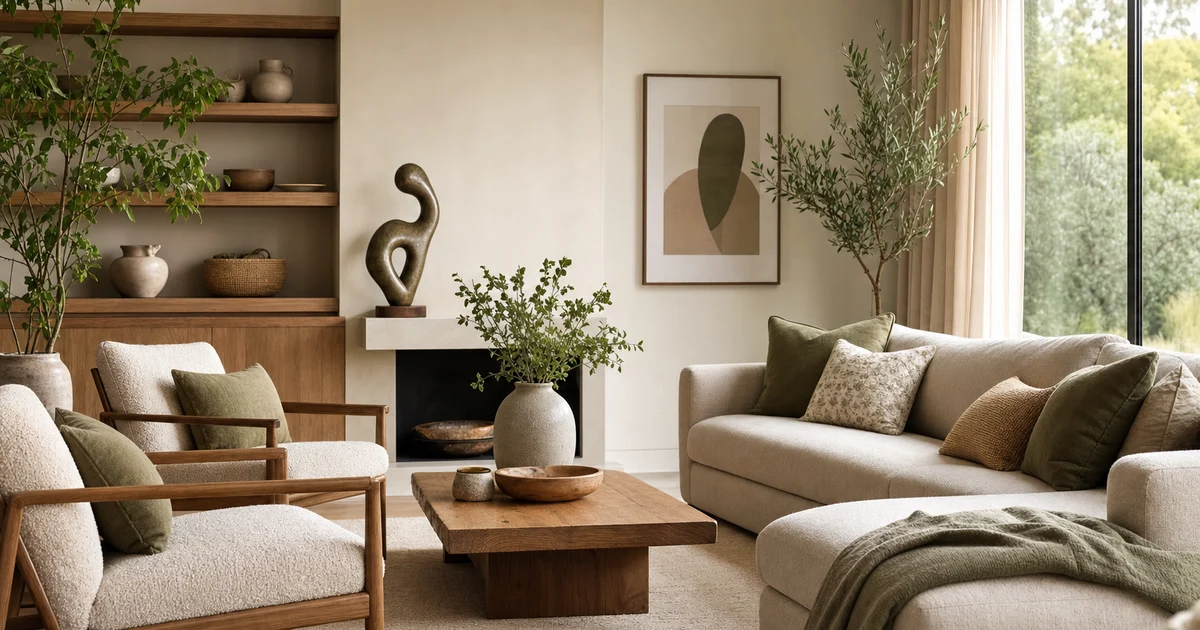
Color palette. Start with a calm neutral base, then add restraint.
- Warm whites, soft cream, greige (gray-beige), oatmeal, and putty for walls and large pieces.
- Grounding darks in small doses: charcoal, espresso brown, matte black on frames and hardware.
- One or two current accents only: terracotta, sage or olive green, dusty blue, or ochre, used in a throw, a chair, or art rather than everywhere.
Materials and finishes. Natural and tactile beats shiny.
- Light to mid-tone woods: oak, ash, and walnut for warmth.
- Natural stone and quartz, especially honed (matte) finishes over high gloss.
- Matte black or brushed brass metal, plus a little glass to keep things light.
- Concrete or microcement as a calm, modern surface for a coffee table or floor.
Furniture. Clean lines with a soft edge.
- Low, simple silhouettes with rounded corners and gently curved arms.
- A streamlined sofa in a neutral weave, paired with a sculptural accent chair.
- Legs that lift furniture off the floor, so the room feels open.
- Quality over quantity: fewer, better pieces with room to breathe.
Lighting. Layer it, never rely on one ceiling fixture.
- A sculptural statement piece (a linear pendant or a slim arc floor lamp).
- Recessed or track lighting for even, shadow-free ambient light.
- Warm bulbs around 2700K to 3000K so the neutrals stay cozy, not clinical.
Textiles. Texture does the work that pattern does elsewhere.
- Boucle, wool, linen, and cotton in tonal layers.
- A chunky knit throw, a low-pile or flatweave rug, and a couple of textured cushions.
- Pattern stays subtle: a quiet stripe or organic shape, not a loud print.
Layout. Open, intentional, and uncluttered.
- Clear sightlines and deliberate negative space around key pieces.
- One focal point per room: a sofa, a fireplace, or a single large artwork.
- Surfaces kept mostly clear, with storage that hides the daily clutter.
This sits close to minimalist interior design, but contemporary allows more warmth, texture, and color, so it rarely feels austere.
How to get a contemporary look, step by step
You do not need to redo everything at once. Work in this order and the room comes together without feeling forced.
- Set the base. Pick one warm neutral for the walls and large furniture. This is the canvas everything else sits on.
- Choose one accent. Add a single current color (say sage or terracotta) and repeat it two or three times around the room for cohesion.
- Edit the furniture. Keep clean-lined, low pieces with soft edges. Remove anything ornate or bulky that fights the calm.
- Layer the lighting. Add ambient, task, and one statement fixture, all on warm bulbs.
- Build texture. Bring in boucle, wool, linen, and a rug so the neutral palette feels rich, not flat.
- Add one focal point. A single large artwork or a sculptural object gives the eye somewhere to land.
- Clear the surfaces. Tidy counters and shelves, then style with a few intentional objects and a plant or two.
Common mistakes, and how to avoid them
Most contemporary rooms fail in one of a few predictable ways. Each has a simple fix.
- It feels cold. All-white and all-hard-surfaces reads like a waiting room. Fix it with wood tones, warm bulbs, and soft textiles like wool and boucle.
- You chased one trend. Filling a room with a single viral look dates it fast. Keep the base timeless and let trends live in cheap, swappable items: cushions, art, a throw.
- Everything matches too perfectly. A matched set feels like a catalog. Mix materials and one or two eras (a little mid-century or industrial) so it feels collected.
- No focal point. Evenly spread attention makes a room feel busy and unresolved. Choose one hero element per room.
- Too much stuff. Contemporary lives on negative space. If a surface is crowded, remove half and let the rest breathe.
Contemporary on a budget and in a rental
This style is friendly to small budgets and to walls you are not allowed to touch, because most of the impact is in color, texture, and editing rather than expensive built-ins.
- Paint first. A single neutral on the walls is the cheapest, highest-impact change. In a rental, peel-and-stick options or a landlord-approved repaint go a long way.
- Swap, do not rebuild. New cushion covers, a flatweave rug, and a throw shift the whole mood for very little.
- Change the hardware and lighting. Matte black or brushed-brass knobs and a plug-in arc lamp instantly read contemporary, and both come with you when you move.
- Declutter for free. Clearing surfaces and hiding cables costs nothing and is half the look.
- Shop slow. Buy one good clean-lined piece at a time instead of a cheap matched set you will replace.
If your space leans warehouse, the same logic applies to a softer take on industrial interior design: keep the raw materials, add warmth, and edit hard.
Try it on your own room with MINIROOM AI
The fastest way to know whether contemporary suits your space is to see your actual room redesigned, not a stranger's. That is exactly what the AI interior design app is for, and it is free to start on Google Play.
- Photograph the room. Open MINIROOM AI and take a clear, well-lit photo of the space you want to change. A straight-on shot with the whole room in frame works best.
- Prompt for a contemporary redesign. Choose the contemporary style, then add a short prompt: a neutral base like greige, one accent such as sage green, soft curved furniture, and warm layered lighting.
- Generate. Let the app redesign your real room in that style, keeping your layout recognizable so you can picture it.
- Compare. Put the AI version side by side with your original photo to judge the change honestly, and generate a couple of variations to test a different accent or a warmer wood.
- Save and share. Keep the version you love, then share it with a partner, a roommate, or a contractor before you buy a single thing.
Because you are testing on a photo, there is no risk: try contemporary, then a more pared-back minimalist take, then a warmer mid-century lean, and only commit once a result genuinely feels like home.
See a contemporary version of your room.
Open MINIROOM AI on Google Play and try a clean contemporary redesign from a photo.

Frequently asked questions
What is contemporary interior design in simple terms?
It is the current, of-the-moment look: clean lines, a calm neutral palette, natural materials, soft curves, layered lighting, and a few present-day accents, kept uncluttered so the room feels fresh and easy to live in. Because it tracks the present, it keeps evolving over time.
What is the difference between contemporary and modern design?
Modern refers to a fixed historical movement (early to mid 20th century) with set traits like low furniture, teak and walnut, and bold primary colors. Contemporary has no fixed era; it reflects whatever is current now, so it tends to be softer, warmer, and more neutral. A contemporary room can still borrow modern pieces.
What colors are used in contemporary interior design?
A neutral base does most of the work: warm white, cream, greige, oatmeal, and putty, grounded with charcoal, espresso, or matte black in small doses. Add only one or two current accents, such as terracotta, sage green, dusty blue, or ochre, used in a throw, a chair, or art.
Why does my contemporary room feel cold?
Usually because there are too many hard, shiny surfaces and not enough warmth. Add natural wood tones, switch to warm bulbs (around 2700K to 3000K), and layer soft textiles like wool, linen, and boucle. Texture and warm light are what stop a neutral room from feeling clinical.
Is contemporary the same as minimalist?
They are close relatives but not identical. Minimalist strips a space down to the essential and leans on negative space. Contemporary keeps the clean, uncluttered feel but allows more warmth, more texture, and a touch more color, so it generally reads as cozier than strict minimalism.
Can I do contemporary design on a budget or in a rental?
Yes. Most of the impact comes from paint, texture, and editing rather than expensive built-ins. Repaint in one neutral (or use renter-friendly options), swap cushion covers and rugs, change hardware and lamps, declutter surfaces, and buy one good clean-lined piece at a time.
How do I make a room contemporary step by step?
Set a single neutral base, pick one accent color and repeat it a few times, edit furniture down to clean-lined low pieces, layer ambient, task, and one statement light on warm bulbs, build texture with wool and boucle, add one focal point, and keep surfaces mostly clear.
How can I preview a contemporary makeover before buying furniture?
Use MINIROOM AI on Google Play. Photograph your room, choose the contemporary style and add a short prompt (neutral base, one accent, soft curves, warm lighting), generate the redesign, compare it side by side with your original, then save and share the version you like before spending anything.